
Bespoke Curtain Poles, Supply & Fitting
Curtain Poles and Tracks,
Cut to Length and Fitted
to Carry Real Weight
Hardware sized to the span and the finished curtain weight, fixed into something solid, and fitted before your curtains arrive, so the pole is right on the day the fabric goes up rather than a problem discovered at the end.
Send us the window widths, or book a measure visit. We will tell you what the span needs before you buy anything.
Who You Are Dealing With
- Experience
- Transforming properties for over 15 years
- Consultation
- Free, in your own home
- Workroom
- Marsh Road, Pinner
- Measured & fitted
- Managed by us end to end
- Fabric viewing
- In your own room and light
- Registered company
- Adey Interiors Ltd · 11091485
- Guarantee & insurance
- Not Provided
What this service is, and who it is for
What the service covers
We specify, supply and fit curtain poles, tracks, brackets, rings, finials, bends, cording sets and hold-backs. Poles and tracks are cut to the width of the opening rather than fitted at a stock length, so returns, overlaps and stack-back are all correct for your window.
The specification covers diameter, bracket count and spacing, fixing method, projection from the wall, and the height at which the hardware sits, which is set by the heading style and the ceiling, not by the top of the window.
Supply and fitting are handled together, so brackets, returns and finials are correct before your curtains arrive.
Who it is for
Anyone having curtains made, and anyone whose existing hardware is the actual problem: a pole that sags in the middle, brackets pulling out of plasterboard, a track that will not run smoothly, or a bay window with three separate poles that do not line up.
It is also for period homes in Kensington, Chelsea, Belgravia, Hampstead and Primrose Hill where cornices, deep reveals, shutter boxes and lath-and-plaster walls make a straightforward fixing anything but straightforward.
When it is needed
Before curtains are made, ideally. The fitted position of the pole determines the finished drop, so the hardware decision comes first and the fabric is measured to it.
Also when curtains have become hard to draw, when a pole has visibly bowed under interlined fabric, after replastering or new windows have changed the fixing surface, or when a bay is being dressed as one sweep for the first time.
Why it should not be improvised
Interlined curtains across a wide window are heavy, and that weight is carried by a handful of screws in a wall. Bracket spacing, pole diameter and the substrate behind the plaster are structural questions, not accessories.
The second reason is geometry. Stack-back, the width the open curtain occupies, decides whether you still see the glass. Returns decide whether light leaks down the sides. Projection decides whether the curtain clears the radiator, the sill or the shutter. Get those wrong and the curtains are fine but the window does not work.
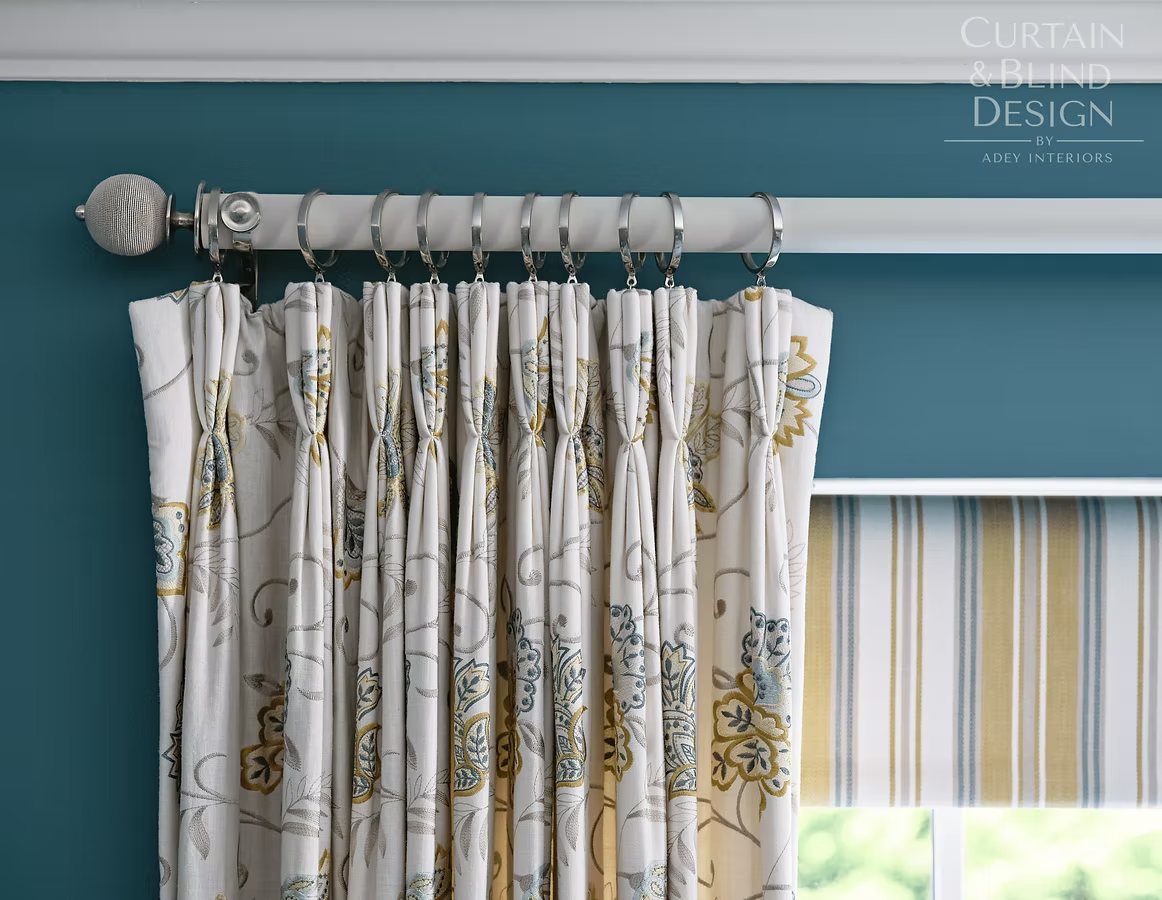
Bespoke Curtain Poles, Supply & Fitting in our clients' homes

What it costs you to leave it
Brackets pulling out of the wall
A heavy pair fixed into plasterboard without a noggin or a proper fixing eventually tears out. The repair is not a screw, it is a damaged wall, a redecoration and often the curtain heading torn where it fell.
A bowed pole and a curtain that jams
Undersized diameter or too few brackets across a long span lets the pole dip in the middle. Rings then bunch at the low point and the curtain has to be pushed rather than drawn, every day.
Glass you never see again
A pole cut too short for the stack means the open curtain sits over the glazing permanently, so the room loses daylight it should have and the window looks smaller than it is.
How the work runs
Step 1
Measure and survey the fixing
We measure the opening, the wall either side, the projection needed to clear sills, radiators or shutters, and check what is behind the plaster: masonry, timber, lath or plasterboard.
Step 2
Specify hardware to the load
Diameter, bracket count, bends and cording are chosen against the finished weight of the curtain including lining and interlining, and against the unsupported span between brackets.
Step 3
Set the height and the stack
Fitting height is set from the ceiling, cornice and heading style; stack-back and returns are calculated so the open curtain clears the glass and the closed curtain seals the edges.
Step 4
Cut to length and prepare
Poles and tracks are cut to the measured width, bay bends are formed to the angles taken on site, and finials, rings, gliders and end stops are made up as a set.
Step 5
Fitting and load testing
Brackets are fixed into a solid substrate with the correct fixings, the run is checked for level along its whole length, and the assembly is loaded and drawn before fabric goes anywhere near it.
Step 6
Handover and completion
The pole or track is left ready for the curtains, with cording and overlap adjusted, and we confirm the finished drop measurement from the fitted rings so the making-up is dimensioned to reality.
What you get from it
Curtains that draw with one hand
Correct diameter, bracket spacing and glide choice mean the curtain moves smoothly instead of being wrestled across a dipped pole.
Fixings you do not have to think about
Load is taken into masonry or timber with fixings chosen for the substrate, so heavy interlined pairs stay where they were put.
Full daylight retained
Poles cut for the real stack-back keep the open curtain off the glazing, which is the difference between a bright room and a permanently half-dressed window.
Light sealed at the edges
Proper returns to the wall stop the light leak down the sides of a curtain, which is what people notice most in a bedroom.
Bays that read as one sweep
Bends formed to the angles measured on site let a single run follow a bay, rather than three poles at slightly different heights.
No gap between trades
Because the hardware is ours and the curtains are ours, the drop is measured from the fitted rings and nobody is blaming anybody for two millimetres.
Materials, methods and variations
Poles, tracks and when each is right
A pole is chosen when the hardware is meant to be seen: timber, painted, brass, nickel or blackened steel, with finials as part of the room's detail. It suits eyelet, pencil, pinch pleat and goblet headings on spans a bracket run can support comfortably.
A track is chosen when the hardware should disappear or when the mechanics matter more than the look: very wide spans, wave headings, ceiling fixing, bay curves, corded or motorised operation, or a curtain that must sit tight under a cornice. Tracks can be face-fixed, ceiling-fixed or set into a pelmet board.
Some rooms need both: a track for a sheer or voile layer behind, and a pole for the main curtains in front, which gives daytime privacy and full night-time cover on the same window.
Materials, diameters and finishes
Diameter is a load decision first and an aesthetic one second. Slim poles suit light cottons and short drops; heavier interlined curtains on wide spans need a larger diameter and more brackets, and a centre support bracket is often the difference between a straight pole and a sagging one.
Timber poles can be painted or stained to match joinery, which works well in period rooms where a metal finish would sit oddly against the woodwork. Metal poles in brass, antique brass, nickel, chrome and matt black carry more weight in a smaller diameter and suit contemporary and industrial schemes.
Rings, gliders and runners are matched to the heading and the material so the curtain does not catch. Cording sets are specified where a curtain should never be handled directly: pale fabrics, high drops or a heading that would be pulled out of shape by hand.
Difficult situations we specify for
Bay windows need bends formed to the measured angles, and a decision about whether the curtain passes the bends on a corded system or sits as separate pairs at each facet. Corners and returns need enough clearance that rings can pass without binding.
Long unsupported spans across bi-folds and picture windows need intermediate support without blocking the draw, which usually means a track with ceiling fixings rather than a pole with wall brackets.
Recessed and corniced ceilings limit the height available above the window; the fix is often ceiling fixing or a pelmet board rather than trying to squeeze a bracket under a cornice. Shutter boxes, deep reveals, radiators under sills and window seats all change the projection required, and each of those is measured rather than assumed.
Homes and contract settings
In private homes the hardware is part of the room's detail, so finish, finial and pole diameter are chosen alongside the fabric and the joinery.
In lettings, developments and hospitality interiors the priorities are robustness and repeatability: tracks that survive heavy use, fixings that hold up under turnover, and identical specifications across many identical openings. That work sits with our contract curtains and voiles service.
Local wall construction, and long-term maintenance
Fixing substrate varies enormously between the areas we work in, and it is the detail that most often decides how a pole performs. Victorian and Edwardian houses in Pinner, Northwood and Rickmansworth typically have solid masonry above the window with lath and plaster elsewhere, so bracket positions are set by where the masonry actually is rather than by even spacing on a drawing.
Period townhouses and mansion flats in Kensington, Chelsea, Belgravia, Hampstead and Primrose Hill add cornices, shutter boxes and panelling. Where a cornice leaves no room for a wall bracket, the honest answer is a ceiling-fixed track or a pelmet board rather than forcing a bracket into a compromised position. Newer houses and extensions in Chalfont often have plasterboard on metal or timber stud, which needs noggins or load-rated fixings identified before the pole is ordered.
Maintenance afterwards is minimal but worth knowing. Metal poles need nothing beyond an occasional dust; timber poles should be kept out of persistent damp. Corded track systems benefit from having the cord tension checked once a year, and gliders can be replaced individually rather than changing a whole track. If a curtain begins to feel heavier to draw, it is usually a glide or a bracket that has moved rather than the pole itself, and that is a short visit rather than a replacement.
Questions we are asked
How much does it cost to supply and fit curtain poles?
It depends on the span, the material and finish, the number of brackets and whether bends or cording are needed. Published price ranges: Not Provided. We measure and quote per window in writing before ordering.
How long does fitting take?
Most rooms are a single visit once the hardware has arrived. Lead time depends on the pole or track range and any bends being made to size. Stated turnaround times: Not Provided.
Can you fit poles for curtains I bought elsewhere?
Yes. Bring us the curtain width, drop, heading and weight and we will specify hardware that suits them, then fit it and confirm the hanging height.
Can you fix a pole into plasterboard?
Only with a proper approach: locating the timber behind it, or using fixings rated for the actual load. We will tell you at survey what the wall can take rather than fixing and hoping.
How high above the window should a pole go?
Higher than most people expect. Fitting height is set by the heading depth and the ceiling or cornice, and raising it gives a taller-looking window and keeps the heading clear of the glass. We set the exact figure on site.
Can you do a single pole around a bay window?
Yes. Bends are formed to the angles measured at your bay, and we agree whether the curtains pass the bends on a corded system or sit as separate pairs at each facet.
How long will the hardware last?
Correctly loaded poles and tracks are long-term fittings rather than consumables, but we will not publish a lifespan figure we cannot stand behind. Bracket spacing and fixing substrate are what decide it in practice.
Is the fitting guaranteed?
Guarantee terms: Not Provided. Tell us what you need confirmed and we will set it out in writing with the quotation.
Can you come out urgently if a pole has come down?
Emergency callout availability: Not Provided. Call 07961 112309, tell us what has failed, and we will give you an honest date.
Do you fit hardware across London as well as Pinner?
Yes: Pinner, Northwood, Rickmansworth and Chalfont locally, and Kensington, Chelsea, Belgravia, Hampstead and Primrose Hill in London.
Where this work takes us
Next Step
Get the hardware specified before the fabric is cut
Send the window widths or book a visit. We will measure the span, check the fixing, specify pole or track to the finished curtain weight, and put a written price to it.
Send us the window widths, or book a measure visit. We will tell you what the span needs before you buy anything.