
In-Home Fabric Selection
In-Home Fabric Selection,
Judged in Your Own Light
and Measured the Same Visit
Fabric behaves differently at your window than on a showroom rail, so the samples come to you, the decision is made against your own walls and daylight, and the measurements are taken while we are there.
Book a visit at a time of day the room matters most. No showroom trip, no obligation to order.
Who You Are Dealing With
- Experience
- Transforming properties for over 15 years
- Consultation
- Free, in your own home
- Workroom
- Marsh Road, Pinner
- Measured & fitted
- Managed by us end to end
- Fabric viewing
- In your own room and light
- Registered company
- Adey Interiors Ltd · 11091485
- Guarantee & insurance
- Not Provided
What this service is, and who it is for
What the visit is
We bring fabric samples to your home so colour and texture can be judged against your walls, flooring and daylight, rather than under retail lighting on a rail of competing colours.
Measurements are taken at the same visit, which removes a step and keeps the decision in one place, you are not choosing fabric on one day and discovering the window's constraints on another.
The visit covers face fabrics, linings and interlinings, trims and hardware finishes, and the practical questions that go with them: how dark the room needs to go, what the curtain has to clear, and where the hardware can be fixed.
Who it is for
Anyone who has struggled to commit from a small swatch. A 10cm sample tells you almost nothing about how a fabric drapes, how it reads at three metres, or what it does when the light comes through it.
People with awkward diaries or young children, for whom a showroom appointment is a logistical exercise. And anyone in a period home in Kensington, Chelsea, Belgravia, Hampstead or Primrose Hill where the room's light is the whole point and cannot be replicated elsewhere.
Also for clients working at distance through a designer or agent, where a decision has to be made once and made correctly.
When it is needed
Before any fabric is ordered, and ideally after the walls and flooring are decided: those are the surfaces the fabric has to sit against, and choosing fabric first constrains them.
Book the visit for the time of day the room matters most: morning for a bedroom or kitchen, late afternoon for a sitting room you use in the evening. The same fabric can read warm at nine and grey at five.
Why the room, not the showroom
Daylight has a colour temperature that changes with orientation and time of day, and retail lighting is chosen to flatter fabric. A colour approved under halogen and then hung in a north-facing room is the single most common expensive mistake in this trade.
Scale is the second reason. Pattern repeat and weave texture read completely differently across a full drop than in a hand-sized swatch, so we bring larger pieces and hold them at the window at the height they will hang.
Third, the practical decisions belong in the room. Whether a curtain can clear the radiator, where the pole can be fixed, how much light leaks at a reveal: these are answered at the window, not described over a counter.
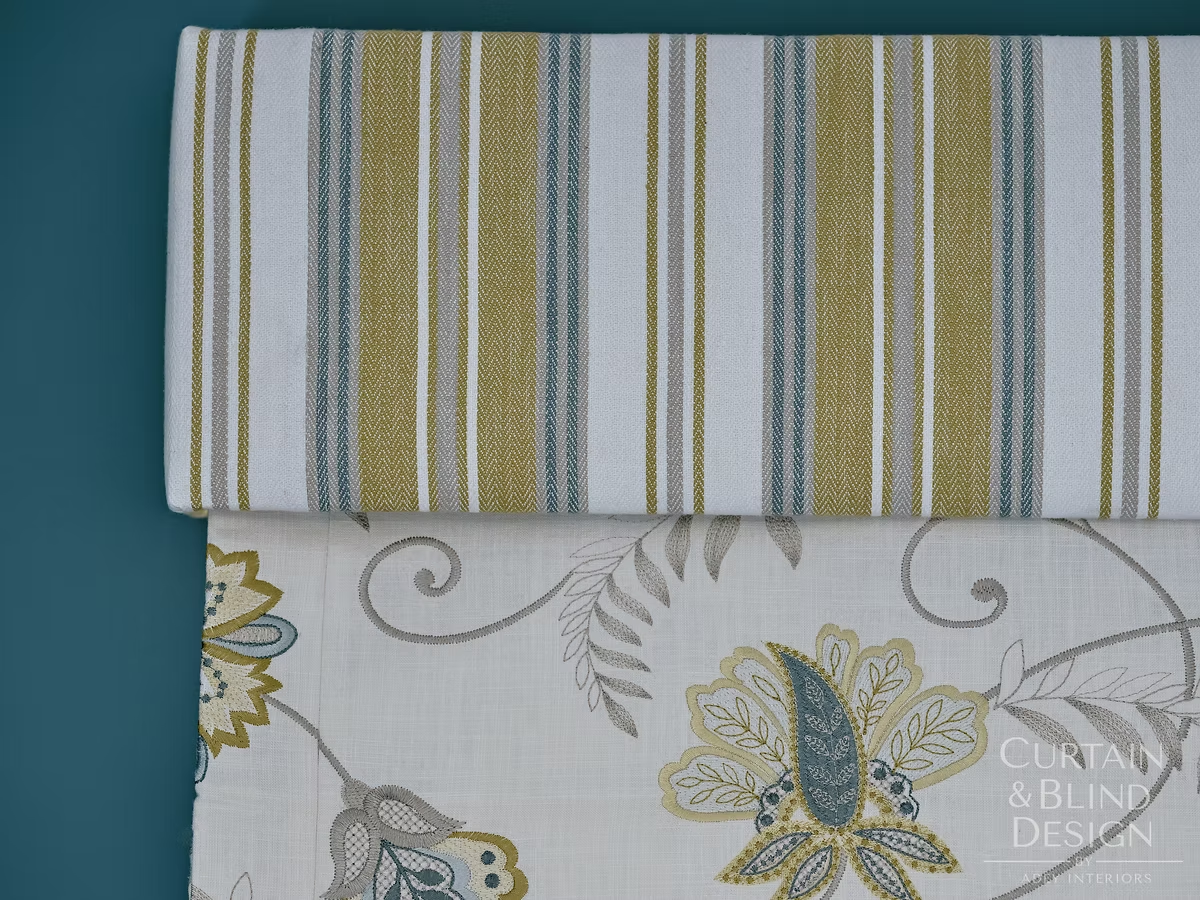
In-Home Fabric Selection in our clients' homes
What it costs you to leave it
A colour that changes at home
Fabric approved under showroom lighting and hung in a north-facing room frequently reads colder and flatter. By then the fabric is cut, so it is a fresh order rather than an exchange.
Pattern scale misjudged from a swatch
A repeat that looks delicate in the hand can dominate a full drop, and a subtle texture can disappear entirely. Both are obvious when a large piece is held at the window and invisible on a sample card.
Two visits, two chances to drift
Choosing fabric in one place and measuring in another means the window's constraints arrive after the decision, which is how a specification quietly changes and a budget moves.
How the work runs
Step 1
Book for the right time of day
We agree an appointment when the room's light is the light that matters to you, and confirm which rooms and windows are in scope.
Step 2
Understand the room
On arrival we look at orientation, existing finishes, furniture that is staying and how the room is used, so the samples we open are relevant rather than exhaustive.
Step 3
View fabrics at the window
Samples are held at the window at hanging height, against the wall and the flooring, and gathered by hand so you can see how they drape and how light passes through them.
Step 4
Fix linings and details
Lining, interlining, heading style, trims and hardware finish are decided in the same conversation, since each one changes how the chosen fabric will actually look and perform.
Step 5
Measure while we are there
Openings, drops, reveals, projections and fixing surfaces are recorded, including what the curtain or blind has to clear, so the specification is dimensioned to the real window.
Step 6
Written specification and price
You receive the selections and measurements in writing with a price, so nothing is ordered until you have seen the whole decision on one page.
What you get from it
Colour decided where it will live
Judging fabric in your own daylight against your own finishes removes the most common cause of regret and re-ordering.
Drape and scale seen properly
Large pieces held at hanging height show how a pattern reads across a full drop and how the fabric gathers, neither of which a swatch can tell you.
One visit instead of several
Fabric, lining, hardware and measurements are all settled in a single appointment, with no showroom trip and no second survey.
Practical problems caught early
Radiators, shutter boxes, uneven floors and awkward fixings are identified at the window, before they become a change to a placed order.
Fewer, better options
Because we see the room first, you are choosing between a handful of appropriate fabrics rather than a wall of possibilities.
A decision you can stand behind
Everything is recorded in writing - fabric, lining, heading, hardware, measurements - so you are approving a specification, not a memory.
Materials, methods and variations
Light, orientation and how fabric behaves
North-facing rooms receive cool, steady light that mutes warm colours and can make a grey read blue. Warm-toned fabrics and textured weaves generally do more work there than flat cool colours.
South and west-facing rooms receive strong, changing light, which flatters warm and mid tones but is also where fading is a real risk, so lining and fabric light-fastness matter as much as colour choice.
East-facing rooms are bright early and flat later, which is why a bedroom sample is best judged in the morning. In every case we look at both transmitted light through the fabric and reflected light on its surface, since a fabric can be one colour lit from behind and another lit from the front.
What we bring, and what we look at
Face fabric samples in the relevant colour families, plus lining and interlining samples so you can see how each changes the weight, drape and light transmission of the fabric you like.
Trims, borders and leading-edge options, which are frequently the cheapest way to lift a plain fabric, and hardware finishes so pole or track material can be judged against your joinery and ironmongery rather than in isolation.
We look at how the fabric gathers by hand, what the repeat does across a width, whether the weave shows a directional sheen, and how it sits against skirting, cornice and flooring at the height it will actually hang.
Fabric families and where each suits
Linens and linen blends drape softly and crease as part of their character, which suits relaxed rooms and looks right in period houses. Wools and wool blends hold weight and hang beautifully on long drops. Cottons and cotton satins take print crisply and suit tailored schemes and Roman blinds.
Velvets add depth, absorb sound and suit sitting rooms and bedrooms with hard floors. Silks and faux silks carry sheen for formal rooms but need lining and interlining to protect them from strong sun. Voiles and sheers are for filtered light and daytime privacy rather than cover.
Every one of those decisions interacts with lining: cotton sateen for general use, blackout for bedrooms and nurseries, dim-out where blackout would be too flat, and thermal where a window is single glazed and cold. Interlining changes drape, insulation and hardware loading, so it is chosen at the same time.
Private homes, designers and contract projects
For private clients the visit is the whole decision made comfortably at home, usually with the whole room's soft elements considered together, which overlaps with our soft furnishings consultations.
For designers we work to a scheme already set and bring options within it, providing the technical specification and measurements to sit alongside their drawings.
For contract projects the same visit becomes a sample-approval exercise against a window-type schedule, with availability across the programme checked before sign-off.
Local rooms, and what happens after the visit
Room light varies more than people expect across the areas we cover. North-facing front rooms in Victorian terraces around Pinner and Rickmansworth receive steady, cool light all day, and fabrics chosen there need warmth in the undertone or the room reads grey whatever the paint colour. Rear extensions in Northwood and Chalfont often have very high light levels through roof glazing, so fade resistance and lining choice matter more than colour subtlety.
Tall sash windows in Kensington, Chelsea and Belgravia throw a lot of light deep into a room, which flatters textured weaves and shows every detail of a heading. Garden-facing rooms in Hampstead and Primrose Hill change character completely between summer and winter as foliage comes and goes, and it is worth knowing that when judging a fabric in July for a room you mainly use in December. We will raise it rather than let the sample flatter itself.
After the visit you receive the selections and measurements in writing: face fabric and reference, lining or interlining, heading, fullness, hardware and finish, fitting position and finished drop per window, with the price attached. Where a decision is finely balanced we can leave samples with you so the fabric can be seen over several days and different weather rather than in one appointment. Nothing is ordered until you confirm, and once you do the same specification carries straight through to making and fitting without being re-interpreted.
Questions we are asked
Is there a charge for an in-home fabric visit?
Visit and consultation charges: Not Provided. Ask when you enquire and we will confirm the arrangement in writing before we come out.
How long does the visit take?
It depends on the number of rooms and windows in scope. Typical appointment lengths: Not Provided. We will tell you what to expect when the appointment is booked.
Do I have to order on the day?
No. The point of the visit is a decision you are comfortable with. You receive the selections and measurements in writing and order when you are ready.
What should I have ready before you arrive?
Ideally the walls and flooring decided, and any samples you have already collected. Clear access to the windows helps, and it is useful to know which rooms need to go dark.
Can you work with fabric I have already chosen elsewhere?
Yes. We will check the width, repeat, weight and suitability for the window and how you use the room, then advise on lining, heading and hardware to suit it.
What time of day should I book?
Whenever the room's light matters most to you: mornings for bedrooms and kitchens, late afternoon for sitting rooms used in the evening. The same fabric can read differently at those two times.
Do you measure at the same visit?
Yes. Openings, drops, reveals and fixing surfaces are recorded while we are there, which removes a separate survey appointment.
How long will the fabric last in a sunny room?
Direct sun is the main factor and it varies by fabric, so we will not quote a lifespan. Lining and interlining protect the face fabric, and light-fastness is part of what we consider for south and west elevations.
Is the making and fitting guaranteed?
Guarantee terms: Not Provided. Tell us what you need confirmed and it will be included in writing with your quotation.
Which areas do you visit?
Pinner, Northwood, Rickmansworth and Chalfont from our Marsh Road base, and Kensington, Chelsea, Belgravia, Hampstead and Primrose Hill in London.
Where this work takes us
Next Step
Have the fabrics brought to your window
Tell us which rooms you are dressing and when the light matters most. We will visit with samples, judge colour and drape at the window, measure while we are there, and follow up in writing.
Book a visit at a time of day the room matters most. No showroom trip, no obligation to order.