
Soft Furnishings Consultations
Soft Furnishings Consultations
That Resolve One Palette
Across the Whole Room
Curtains, blinds, cushions, throws and upholstery decided together in your own room, so colour, texture and pattern scale work as a set rather than as five separate purchases you hope will agree.
Book a consultation at home. Bring the samples you have already collected, we will work from them.
Who You Are Dealing With
- Experience
- Transforming properties for over 15 years
- Consultation
- Free, in your own home
- Workroom
- Marsh Road, Pinner
- Measured & fitted
- Managed by us end to end
- Fabric viewing
- In your own room and light
- Registered company
- Adey Interiors Ltd · 11091485
- Guarantee & insurance
- Not Provided
What this service is, and who it is for
What a consultation covers
A consultation covers the soft elements of the room together - curtains, blinds, cushions, throws and upholstery - so colour, texture and pattern scale are resolved as a set instead of one item at a time.
We work in the room itself, with samples laid against your walls, flooring, joinery and existing furniture, in the daylight the room actually gets. Decisions are recorded so you have a palette to order against, in stages if you prefer.
It is useful whether you are dressing a single room or working through a house in stages, and it sits naturally in front of our curtain, blind and reupholstery work.
Who it is for
People who have collected samples and stalled. If you have a drawer of swatches and no decision, what is missing is a palette, not another sample.
People part-way through a room: new sofa, old curtains, cushions that no longer relate to either. And people who have moved into a house where every soft element belongs to somebody else's scheme.
It also suits homes being worked through gradually, where each room needs to stand alone and still relate to the last one: common in family houses across Pinner, Northwood, Rickmansworth and Chalfont, and in flats and townhouses in Kensington, Chelsea, Belgravia, Hampstead and Primrose Hill.
When it is needed
Before you buy anything soft, ideally, and certainly before ordering curtain fabric, because curtains are usually the largest single fabric area in the room and set the tone everything else has to live with.
Also after a redecoration, when the hard finishes are settled and the soft ones are the remaining decision, or when one new purchase has quietly thrown the rest of the room out.
Why it is worth doing properly
Colour does not behave in isolation. A grey that reads warm against oak flooring reads cold against a pale porcelain tile, and a fabric chosen under showroom lighting frequently looks different at four in the afternoon in a north-facing room.
Pattern scale is the second trap. Three patterns of similar size compete; the same three patterns in large, medium and small settle immediately. Getting that hierarchy right is a fifteen-minute decision with samples in front of you and a costly one to discover afterwards.
Texture is what stops a neutral room feeling flat. Linen against wool against velvet against a flat cotton creates depth without introducing another colour, which is usually what a tonal scheme is missing.
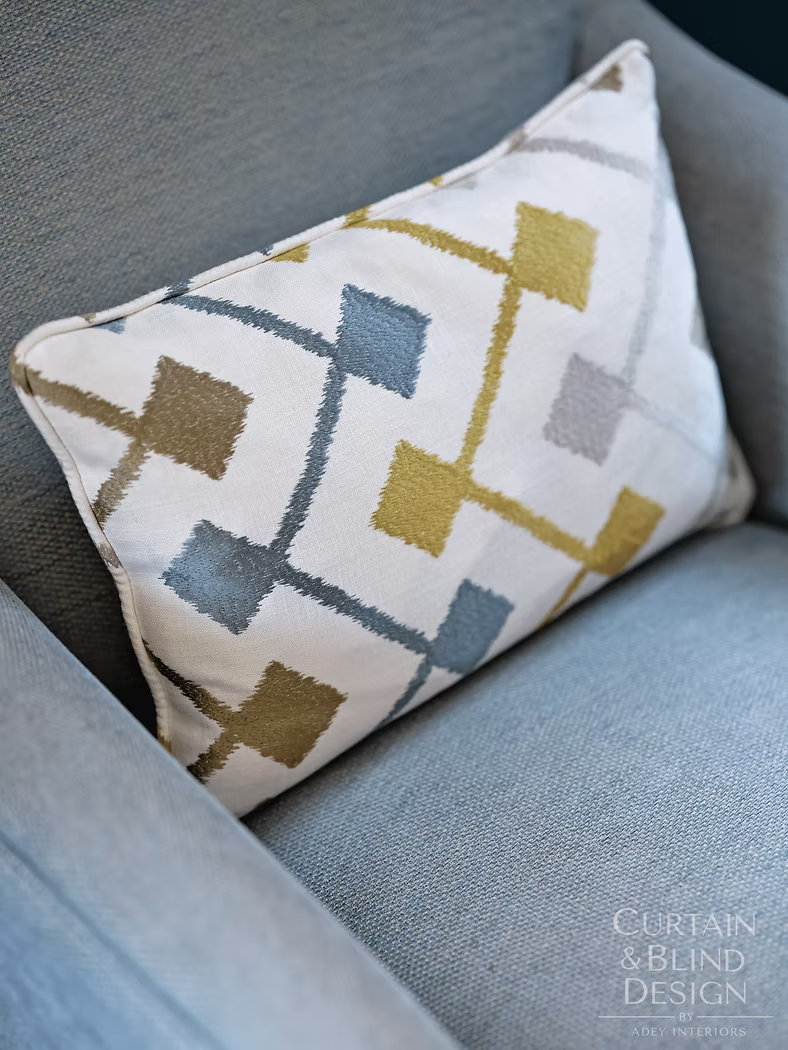
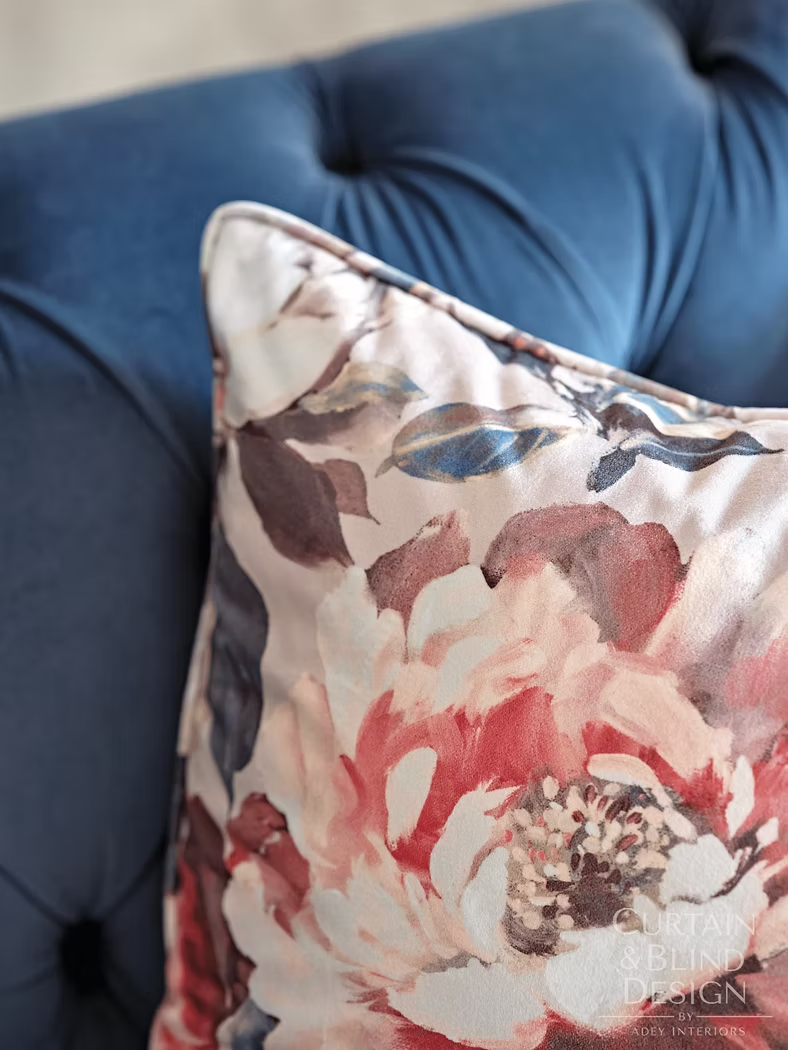
Soft Furnishings Consultations in our clients' homes
What it costs you to leave it
Buying in the wrong order
Cushions and throws chosen before the curtain fabric commit the room's palette to its smallest items. Reversing that means the large fabric spend has to accommodate the small one.
Colours that only worked in the shop
Fabric judged under retail lighting regularly reads differently at home. Discovering that after the curtains are made is a full fabric order lost, not an adjustment.
A room that stays unfinished
Stalled decisions have a cost too: months of a room you avoid using, and eventually a rushed choice made under pressure rather than a considered one.
How the work runs
Step 1
Consultation at your home
We look at the room together - light, orientation, hard finishes, existing furniture and what is staying - and go through any samples you have already gathered.
Step 2
Brief and constraints
We agree what the room must do and what cannot change: a sofa that stays, a rug you love, a floor you are not replacing, and how the room is actually used day to day.
Step 3
Palette built in the room
Fabrics are laid against your walls, flooring and joinery in daylight, and a palette is built with a lead fabric, supporting tones and a pattern hierarchy of large, medium and small.
Step 4
Element-by-element allocation
The palette is assigned: curtain fabric and lining, blind fabric, upholstery, cushion fronts and backs, trims and any throw or bedding, each with the durability its use requires.
Step 5
Written palette and priorities
You receive the agreed selections in writing with a sensible ordering order, so a house can be done in stages without the palette drifting.
Step 6
Making, fitting and review
Whatever you go ahead with is made and fitted by us, and we review the finished room against the palette so later stages still match the first.
What you get from it
One coherent palette
Curtains, blinds, upholstery and cushions chosen together read as a scheme, which is the difference most people cannot name when a room works.
Colour judged in real light
Samples seen in your own daylight against your own finishes remove the most common and most expensive regret in this trade.
Pattern that settles instead of competing
A deliberate hierarchy of large, medium and small pattern lets you use three fabrics in one room without visual noise.
Durability matched to each item
The dining chair, the family sofa and the bedroom cushion get three different specifications rather than one compromise.
Spend directed where it shows
Knowing which fabric is the lead and which is supporting means the expensive fabric goes where it earns its cost.
A house that can be done in stages
A recorded palette means room three still relates to room one, even if there is a year between them.
Materials, methods and variations
Building a palette that holds
Every working scheme has a lead fabric - usually the curtains, because they cover the largest area - plus two or three supporting tones and one accent used sparingly. The lead sets the temperature of the room; the supports carry it into upholstery and cushions; the accent stops the whole thing being polite.
Undertone matters more than colour name. Warm neutrals sit with oak, brass, terracotta and limestone; cool neutrals sit with grey porcelain, nickel, blue-toned paint and darker timbers. Mixing undertones without intent is the usual reason a room full of tasteful choices feels slightly wrong.
Contrast is set deliberately: a tonal, low-contrast scheme reads calm and needs texture to carry it, while a higher-contrast scheme reads sharper and needs fewer competing patterns.
Texture, weave and pattern scale
Texture is the tool for a neutral room. Linen's slub, wool's matt density, velvet's pile depth and a flat cotton's crispness give four different reflective qualities in the same colour family, which creates depth without adding a hue.
Pattern is handled by scale rather than quantity. A large-scale print on the curtains, a medium geometric or stripe on a chair, and a small check or textured weave on cushions can coexist comfortably; three medium florals cannot.
Repeat size has a practical consequence too: large repeats need to be centred and matched, which increases the fabric quantity for curtains and upholstery. That is factored in at consultation so the budget figure is realistic.
Items covered, and how each is specified
Curtains and blinds are specified with lining and interlining for the room's light and warmth requirements. Cushions are specified by size, filling - feather, duck down or fibre - front and back fabric, and edge treatment such as piping, flange or contrast trim. Throws and bed runners are chosen for weight and drape rather than pattern alone.
Upholstery is specified by abrasion rating and cleaning code for how the piece is used, which is covered in detail under our reupholstery service. Headboards, window seat cushions and ottomans are commonly folded into the same palette.
Trims, borders and leading-edge details are where a palette gets tied together economically, a contrast border on a plain curtain costs a fraction of a patterned fabric and often does more for the room.
Single rooms, whole houses and lettings
For one room the consultation is a single focused visit with a written palette at the end. For a whole house we set a circulation palette first - hall, stairs and landing - because it is what every other room is seen against, then detail rooms in the order you plan to spend.
For lettings and show homes the priorities change to durability, cleanability and repeatability across units, with a palette designed to photograph well and survive turnover. That crosses over with our contract curtains and voiles work.
Local rooms, and how a staged palette is kept on track
Rooms in family houses around Pinner, Northwood, Rickmansworth and Chalfont typically have to absorb real use, so palettes there lean on mid tones, textured weaves and darker supporting colours on the pieces that take the wear, with the accent kept to cushions that can be changed cheaply. Open-plan rear extensions need a palette that reads across two zones at once, because the sofa and the dining chairs are seen in the same glance.
Flats and townhouses in Kensington, Chelsea, Belgravia, Hampstead and Primrose Hill more often have tall, formal proportions and strong existing architecture. Palettes there usually carry fewer patterns and more texture, since panelling, cornices and joinery are already providing the visual detail. Where a room has one dominant feature - a marble fireplace, a strong rug, an oak floor - that item is treated as part of the palette rather than something to be worked around.
For houses done in stages, the palette is recorded in a way you can order against months later: the lead fabric and its reference, supporting tones, the accent, the pattern hierarchy, and which element each fabric is allocated to. Circulation spaces are usually specified first, because hall, stairs and landing are what every room is seen against. We keep the record on file, so a cushion made a year after the curtains still belongs to the same room rather than to the sample you happened to like that week.
Questions we are asked
Is there a charge for a soft furnishings consultation?
Consultation fees and how they relate to an order: Not Provided. Ask when you enquire and we will confirm the arrangement in writing before we visit.
How long does a consultation take?
It depends on the number of rooms and how many elements are in play. Typical appointment lengths: Not Provided. We will tell you what to expect when the visit is booked.
Do I have to order everything at once?
No. The palette is recorded so you can order in stages - curtains now, upholstery later - without the scheme drifting between purchases.
Can I use fabrics I have already found?
Yes, and please bring them. We will build the palette around what you already like and tell you honestly if one of them will not work for its intended use.
Do you only recommend fabrics you supply?
We work from what the room needs. Where a piece is better left alone, or another trade should handle it, we will say so rather than adding fabric to the quote.
How many patterns can one room take?
Usually three, provided they are in different scales: large, medium and small. Three patterns of similar scale compete no matter how well chosen each one is.
Will the palette still work if I redecorate the walls later?
We record the undertones and contrast levels behind the palette, so paint can be changed within that logic without unpicking the fabrics you have already bought.
How long should the scheme last?
A palette built on undertone, texture and scale ages better than one built on a trend, but we will not attach a number of years to it.
Is the making and fitting guaranteed?
Guarantee terms: Not Provided. Tell us what you need confirmed and it will be set out in writing with your quotation.
Which areas do you visit?
Pinner, Northwood, Rickmansworth and Chalfont locally, and Kensington, Chelsea, Belgravia, Hampstead and Primrose Hill in London.
Where this work takes us
Next Step
Resolve the whole palette in one visit
Tell us which room is stuck and what is staying in it. We will come with fabrics, build the palette in your own light, and leave you with the selections in writing.
Book a consultation at home. Bring the samples you have already collected, we will work from them.